
HELLO PERIODS Facilitator's Guide
Becoming a Period Educator is a total piece of cake!
In Just 2 Hours with Our 3-Step Blueprint
Introduction Video to Lead your 1st Workshop
"How to" Instruction Video
In this video Aditi Gupta shares how we at Menstrupedia use 'Hello Periods' to conduct menstrual awareness workshops.
How you can conduct such workshops too, using the free resources available on this page.
Your 3 Step BlueprintYour 3 Step Blueprint:
Step 1
Download Hello Periods Workshop Video
"Hello Periods" is an educational video that you can use to conduct workshops. It's recommended that kids have access to the Menstrupedia Comic too.Step 2
Download High Resolution Reference Image
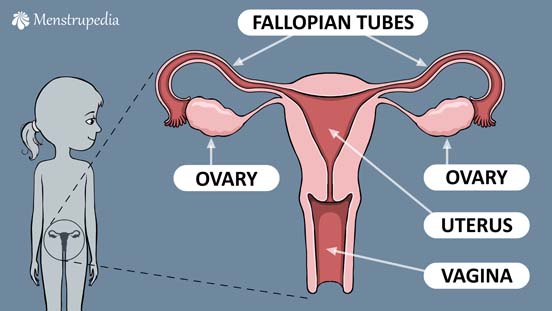
This is a reference image of the female reproductive system that you would need while conducting a menstrual awareness workshop.
Cheat Sheet to Ace your Q/A Session
“HELLO PERIODS” video is segmented into five sections, each with its corresponding Q&A.At the end of each section, find colored pause screens and ensure your workshop audience knows the answers to the associated questions when you see them.
Green Pause at 3 min 13 sec

Q1: What is a sanitary pad and how to use it?
Ans: Sanitary pad is a thin pad of absorbent material that is used to absorb the blood coming out during periods. Sanitary pad is worn in the underwear such that it exactly covers the opening of the vagina.
Q2: How to dispose a sanitary pad? Can sanitary pad be flushed down the toilet?
Ans: Used sanitary pad must be wrapped in a waste paper and put in a garbage bin. Thereafter the lid of the garbage bin must be closed. Sanitary pad should never be flushed down a toilet.
Q3: What to do if you get periods in school?
Ans: We should tell a teacher or school nurse about it and ask her for a pad. We can also borrow a pad from a friend.
Ans: We should take a shower at least once a day. We should wear clean undergarments and change them regularly. Pads should be changed regularly and hands should be washed clean before and after changing pads. Genital area should be kept clean and dry.

Download impact assessment module
If you want to assess the impact of your workshop and convert it into tangible data, you can use this module. This module consists of a pre-test and a post-test to find out the gain in menstrual awareness among the participants after the workshop.
How to Use:
Each folder contains a pre-test and a post-test questionnaire in a word file. As the name suggests, pre-test is conducted before the workshop and post-test is conducted after the workshop.
The questions in the Trainer’s folder have been categorized and labelled under different sections to indicate to the trainer the purpose of each of those questions.
For the purpose of conducting test, the files in the Attendee’s version folder must be printed and used.
Pre-tests must be as short as possible to ensure that the attendees retain their enthusiasm till the end of the test and are eager to participate in the workshop. That is why you’ll notice that the pre-test consists of only five short questions. Post-test on the other hand is more detailed and consists of 11 short questions.
At the end of each test, for each participant, grant her 5 marks for each correct answer and 0 for each wrong answer. For questions where multiple correct answers must be ticked, grant the participant less than 5 marks if she ticks only a few correct answers but not all.
After granting the marks, calculate the percentage: Percentage = (Total marks of the participant x 100) / Total marks in the questionnaire.
Improvement in percentage in post-test for each girl is the improvement due to the workshop.
